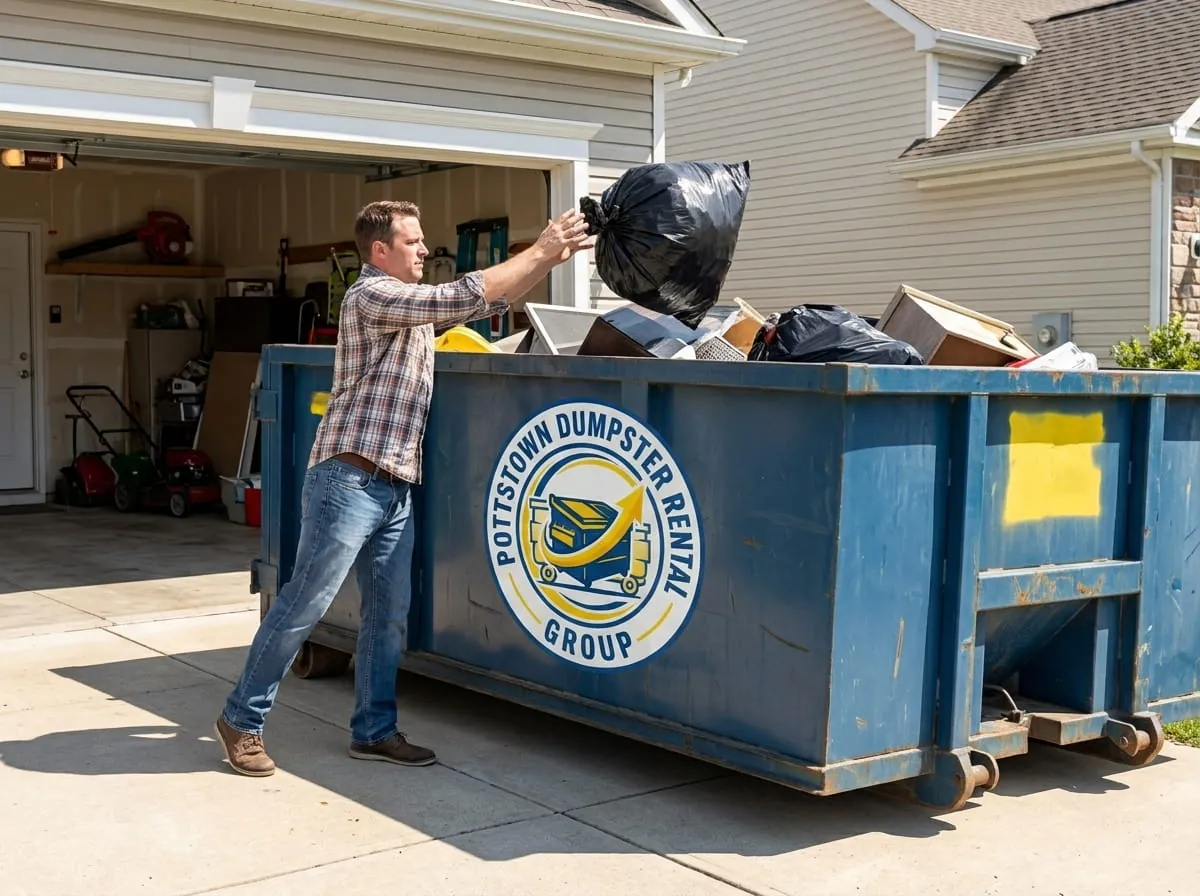
Standing in your driveway staring at a pile of demolition debris, a gutted bathroom, or three decades of accumulated stuff in the basement, one question tends to freeze everyone in place: what size dumpster do I actually need? Order too small and you are paying for a second haul or watching debris spill over the top. Order too big and you are renting expensive empty air that hogs your driveway. Here in Pottstown and across Montgomery County, the answer depends on your project, your debris weight, and how much room you have to place the container. This guide walks you through it in plain terms so you can book with confidence.
How Dumpster Sizes Actually Work
Roll-off dumpsters are measured in cubic yards, which describes volume, not the footprint on your driveway. A "20-yard" dumpster holds 20 cubic yards of material. Because most people cannot picture a cubic yard, the easiest translation is the standard pickup truck bed: one full, heaped pickup load is roughly two cubic yards. That single conversion makes every size click into place.
- 10-yard: about 5 pickup-truck loads. Compact, low walls, fits tight spaces.
- 15-yard: about 7 to 8 pickup loads. The Goldilocks middle for many home projects.
- 20-yard: about 10 pickup loads. The most popular all-around residential size.
- 30-yard: about 15 pickup loads. Tall walls, big volume, for major jobs.
Two numbers govern your choice: volume (how much space your debris fills) and weight (how many tons it weighs). Light, bulky material like furniture and cardboard runs out of volume long before it hits a weight limit. Dense material like concrete, tile, dirt, or plaster does the opposite, so a smaller container is usually the smart call for heavy debris.
Matching the Size to Your Project
Below are the real-world jobs we load every week in the Pottstown area, matched to the size that fits without overpaying.
Small Cleanout or Single Room (10-yard)
Clearing one bedroom, a small deck teardown, a bathroom remodel, or a modest garage purge fits neatly in a 10-yard. Its low sides make tossing debris over the wall easy, and its short footprint slides onto narrow driveways. Choose it when your debris is heavy but low-volume, too, since ripping out a tile floor or a slab of concrete will hit the weight ceiling fast.
Garage, Basement, or Large Cleanout (15-yard)
A packed two-car garage, a full basement dig-out, or a whole-house declutter usually lands in the 15-yard sweet spot. You get meaningfully more volume than a 10 without jumping to the tall walls of a 20 or 30. This is also a smart pick for small kitchen remodels where you are tossing cabinets, countertops, and flooring.
Whole-Home Remodel (20-yard)
When the project touches multiple rooms, a kitchen plus bathroom overhaul, new flooring throughout, or a suburban Montgomery County renovation, the 20-yard is the workhorse. It swallows drywall, old cabinetry, fixtures, carpet, and trim while still fitting most residential driveways. It is the size we recommend most often, which is why we keep a full breakdown on our 20-yard dumpster page. For general home projects, our residential dumpster rental service pairs this size with flat-rate pricing so there are no surprises.
Roofing Tear-Offs (15 to 20-yard)
Roofing is deceptively heavy. Asphalt shingles weigh a ton or more per layer on an average home, so volume is rarely the problem, weight is. A 15-yard handles most single-layer tear-offs on a typical Pottstown home, while a two or three-layer job, or a larger suburban roof, calls for a 20-yard. Because shingles are so dense, never fill a large dumpster to the brim with them, you will blow past the weight limit long before you run out of space.
Construction, Demolition, and Additions (30-yard)
New builds, room additions, large deck and shed teardowns, and full-gut renovations generate framing lumber, drywall, siding, and bulky mixed debris. The 30-yard's tall walls give crews the volume to keep the site clear without constant swaps. Just keep dense demolition debris, concrete, brick, and masonry, in a smaller container to stay under weight.
Estate Cleanouts (20 to 30-yard)
Clearing an entire estate or a hoarding situation means furniture, appliances, boxes, and a lifetime of belongings, all high-volume and relatively light. A 20-yard covers a modest home, while a large multi-story property with a full basement and attic often warrants the 30-yard so the whole job goes in one pull.
Weight Limits: The Number That Trips People Up
Every dumpster comes with an included weight allowance measured in tons. Volume tells you if your debris fits; weight tells you if you can legally and safely haul it. The two are separate ceilings, and heavy material hits the weight ceiling first.
- Light debris (furniture, wood, cardboard, general junk): fill by volume, you will rarely max the weight.
- Heavy debris (concrete, brick, tile, dirt, roofing, plaster): size down and keep loads low.
- Mixed loads: spread heavy items across the bottom and pile lighter material on top.
This matters enormously in Pottstown's older borough neighborhoods. Many of our row homes and pre-war houses were built with plaster-and-lath walls, which are dramatically heavier than modern drywall. A single room of plaster demolition can outweigh an entire houseful of drywall. If you are gutting an older Pottstown home, plan on a smaller container filled partway rather than a big one you cannot legally move.
Will It Fit? Driveway Footprint and Placement
Cubic yards describe capacity, but the container's actual footprint decides whether it fits your property. As sizes increase, dumpsters generally get taller and longer, so a 30-yard needs noticeably more clearance than a 10. Before you book, walk your placement spot and check a few things.
- Length and width: measure your driveway and leave room to open the rear swing door.
- Overhead clearance: watch for low branches, carport roofs, and power lines during drop-off.
- Surface protection: we set boards under the container to protect asphalt and pavers.
- Street placement: tight Pottstown streets sometimes require the container curbside, which may need a borough permit.
Pottstown's dense borough blocks and narrow shared driveways are exactly where sizing matters most. On a cramped lot, a 10 or 15-yard that tucks in cleanly beats a 20-yard that blocks your neighbor or forces a street placement. Out in the more open suburban Montco townships, footprint is rarely the limiting factor, so you can size to the job rather than the space. When in doubt, tell us your driveway dimensions and we will confirm the fit before delivery.
A Quick Size Cheat Sheet for Pottstown Homeowners
When you need a fast answer without re-reading the whole guide, use this at-a-glance recap. Pair the project on the left with the debris type in mind, and you will land on the right size nearly every time.
- 10-yard: single room, small bath remodel, concrete or tile removal, tight borough driveways.
- 15-yard: packed garage, full basement cleanout, single-layer roof tear-off, small kitchen redo.
- 20-yard: whole-home remodel, multi-room flooring, larger roof jobs, mid-size estate cleanout.
- 30-yard: construction and demolition, home additions, full-gut renovations, large estate clear-outs.
Remember the golden rule that trips up first-timers: heavy debris means size down, light and bulky debris means size up. A 30-yard box packed with plaster or concrete becomes impossible to haul, while a 10-yard stuffed with furniture wastes hauls. Volume and weight are two separate ceilings, and the one you hit first decides the job.
When to Size Up, When to Size Down
A few simple rules keep you from guessing wrong. Size up when your debris is light and bulky, when you would rather not risk a second haul on a tight timeline, or when a whole-home project is generating more than you expect (it almost always does). The cost gap between one size up is usually small compared to ordering a second dumpster.
Size down when your debris is dense and heavy, plaster, concrete, tile, dirt, or roofing, because you will hit the weight limit long before you fill the box. Size down, too, when your driveway or street simply cannot accommodate a larger footprint. A right-sized container you can actually place beats an oversized one that causes a headache.
Still on the fence between two sizes? That is the perfect moment to call. Describe your project and debris type, and we will point you to the size that saves you money. Because we are a call-only, flat-rate operation, you get a straight quote with no hidden fees, no online upsells, and no per-pound surprises at pickup. You can reach us anytime at (610) 819-7093 or through our contact page.
Ready to pick the right size? Call Pottstown Dumpster Rental Group at (610) 819-7093 for a fast, flat-rate quote and same-week delivery across Pottstown and Montgomery County.
Founder, Pottstown Dumpster Rental Group — sharing straight advice from more than 15 years of local hauling experience.